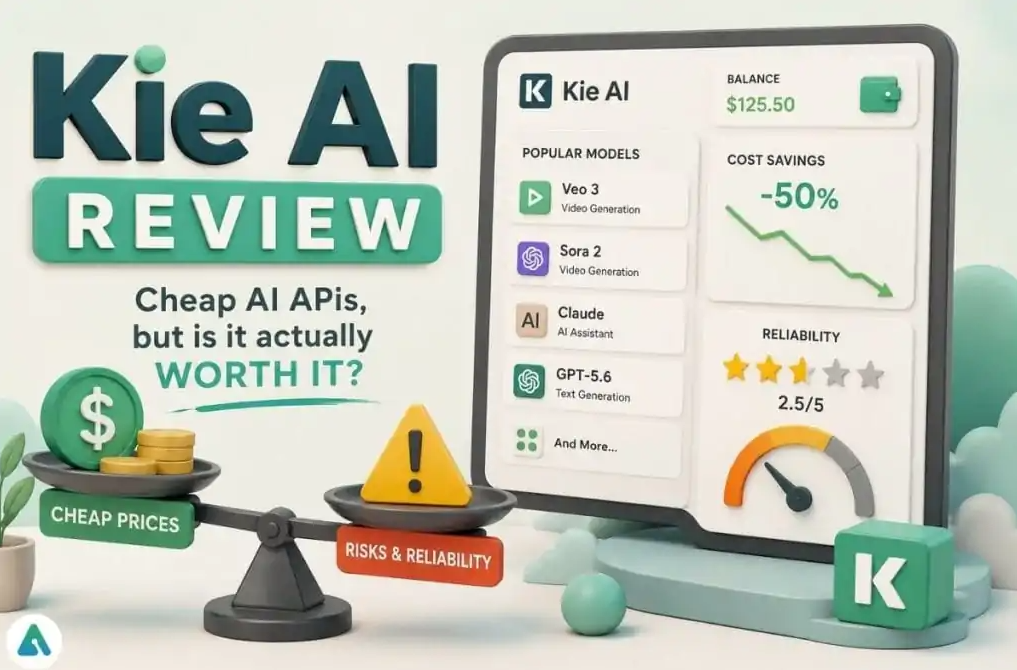
In today’s fast-evolving AI landscape, finding an affordable and reliable API that grants access to top-tier AI models across video, image, audio, and language generation is a challenge for developers and businesses alike. Kie AI addresses this need by offering a unified platform that simplifies integration while reducing costs.
This Kie AI review explores key aspects like Kie AI API pricing, its multi-model capabilities, and seamless integration for AI video, image, and chat APIs. Whether you’re building creative applications or powering sophisticated chatbots, this review will help you determine if Kie AI is the right solution for your projects.
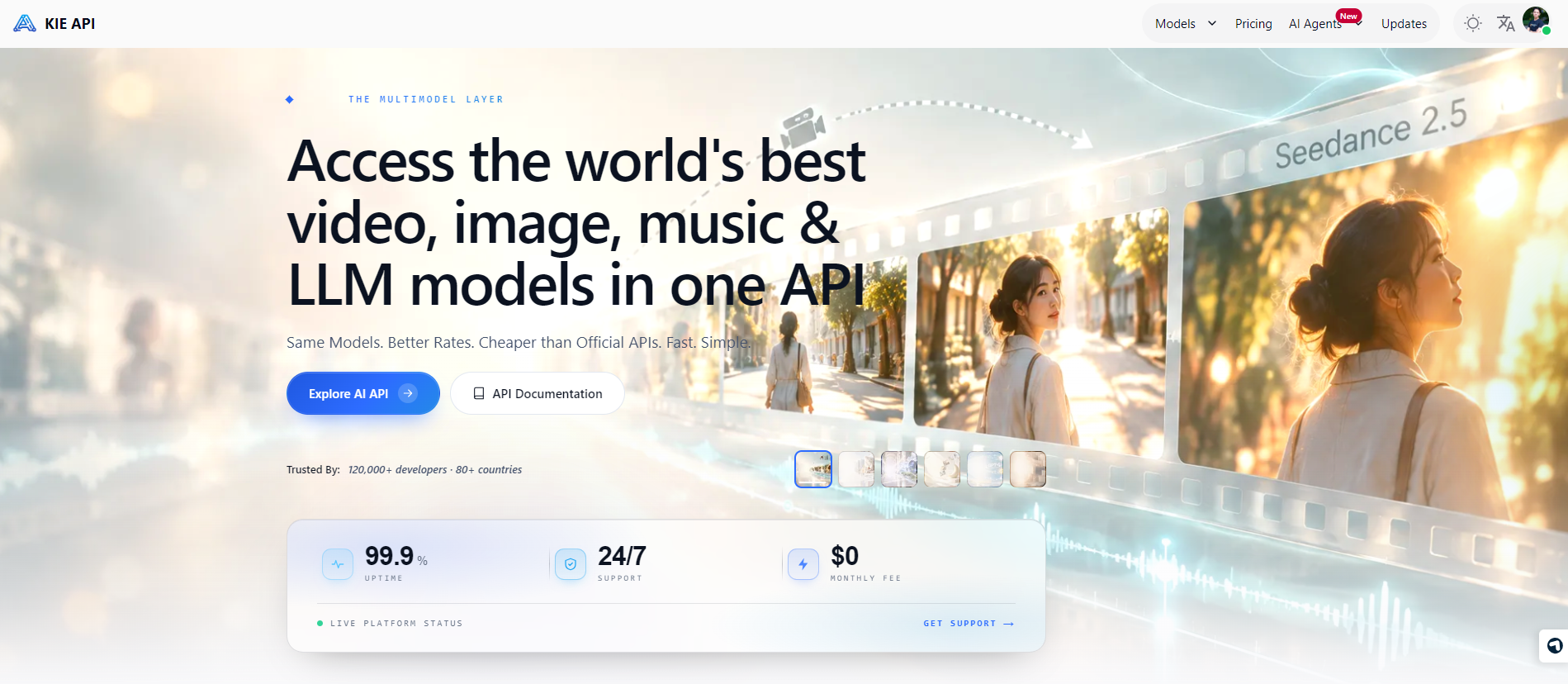
Kie AI is a unified AI platform designed to simplify access to a vast range of advanced artificial intelligence models. Its primary purpose is to offer developers a single, streamlined API that connects to over 100 AI models spanning multiple media types, eliminating the need to manage separate integrations for video, image, audio, and language services. This makes Kie AI especially valuable for teams seeking a cost-effective, reliable solution to build AI-powered applications. One of the standout features of Kie AI is its unified API gateway, which supports asynchronous task requests and webhook notifications, enabling smooth handling of high-volume AI workloads. Developers can easily switch between powerful video generation models like Seedance and Veo, image models such as GPT Image 2 and Nano Banana, audio models including Suno, and large language models like GPT-6 Astra and Claude Opus—all through one consistent interface. This multi-modal approach means Kie AI supports diverse AI capabilities, from generating photorealistic images and expressive videos to synthesizing natural speech and delivering advanced conversational AI. For example, a marketing team can use the video and image APIs to produce rich media content automatically, while developers integrating chatbots or coding assistants benefit from the latest large language models offered on the platform. To get a solid foundation on integrating these types of AI services, consider exploring understanding AI APIs and integration. Overall, Kie AI’s combination of broad model coverage, ease of integration, and transparent pricing provides a practical solution for developers and businesses looking to harness AI technology without the complexity of juggling multiple vendor APIs. For detailed information and to explore their collection of models, you can check out the official website.
Kie AI offers a broad and powerful selection of models that cover video, image, audio, and language processing, making it a go-to platform for developers seeking flexibility and efficiency. For video generation, models like Seedance, Grok Imagine, Veo, Kling, and Wan stand out. Seedance is known for creating up to 30-second 4K clips with advanced multimodal editing, while Grok Imagine excels in turning static images into smooth 720p videos—ideal for creators needing fast, high-volume workflows. Veo and Kling provide high-resolution and cinematic video generation with integrated audio control, supporting varied multimedia applications. In the image domain, Kie AI features the GPT Image series, including GPT Image 2 and 2.5, delivering photorealistic results with sharp details and consistent editing. Nano Banana and Seedream Pro cater to developers seeking professional-grade image generation, offering rapid rendering with high-quality lighting and material accuracy. For audio and speech needs, Suno V6 produces rich vocal and instrumental tracks suitable for music and sound design, while Gemini TTS offers expressive text-to-speech capabilities across over 100 languages, including voice cloning and natural dialogue synthesis. Language models and chat APIs are headlined by GPT-6 Astra, Claude Opus, and Gemini Flash. These models excel at advanced reasoning, coding assistance, and chat applications, providing fast and cost-effective solutions for sophisticated natural language processing tasks. All these models are accessible through a unified API, simplifying integration and model switching without backend overhauls. Developers can experiment freely using the Kie AI Playground, which offers free API testing to fine-tune their applications before full deployment.
Kie AI stands out with its transparent and cost-efficient pricing model designed to fit various AI workloads with simplicity and fairness. Its pay-per-use structure charges users only for actual consumption—be it per generated image, per second of video, or per million tokens processed in language models. This approach lets developers precisely control costs and scale efficiently without hidden fees. Compared to official API pricing, Kie AI offers remarkable savings, often reaching up to 88% less. For example, GPT Image 2 at Kie costs as little as $0.03 per image, while the official API charges $0.21—translating to substantial budget relief, especially for startups and high-volume users. This pricing advantage extends across categories including images, videos like the Grok Imagine Video model, and language models such as GPT-6 Astra. Another compelling feature is Kie AI’s zero-risk billing policy, which means you won’t be charged for failed or incomplete generation tasks. This reduces waste and increases confidence in experimenting or scaling applications without unexpected costs. If you’re looking for an affordable, reliable AI API, Kie AI’s pricing transparency and savings make it a smart choice. Before diving in, you might want to check for any exclusive deals that could help you save even more on your purchase.
When considering the Kie AI review for your applications, several advantages stand out that make this platform a compelling choice. Firstly, Kie AI offers a unified API that gives seamless access to over 100 top-tier AI models across video, image, audio, and language domains. This simplifies development, letting you switch models without rebuilding your entire backend. Secondly, the platform provides significant cost savings—often up to 70% less than official APIs—making it an attractive option for startups and businesses mindful of budget. Reliability is another key benefit, with 99.9% uptime backed by 24/7 monitoring and support to ensure your AI workflows run smoothly around the clock. On the flip side, potential limitations mainly involve rate limits and occasional variations in model availability. Kie AI typically enforces a default limit of 20 new requests per 10 seconds, which suits most users but may require adjustment for very high-demand scenarios by contacting support. Also, since Kie integrates numerous models from different providers, some fluctuations in model access or updates might occur, which calls for occasional adaptation in your application. However, these constraints are generally minor compared to the platform’s benefits and are handled with responsive support. Overall, Kie AI balances speed, cost efficiency, and robust service to empower developers effectively.
Integrating Kie AI into your workflow is designed to be hassle-free, allowing developers to quickly sign up and start experimenting in the Playground. This intuitive onboarding lets you test different AI models for video, image, audio, and chat without any complex setup. The Playground provides a hands-on environment to refine prompts and assess outputs before implementing them in real applications. Kie AI offers a unified API structure that simplifies handling multiple AI services. Rather than juggling different endpoints, all models use the same API pattern, supporting asynchronous task handling for efficient processing. This enables your app to send generation requests and seamlessly manage responses without blocking operations, which is essential for scalable workflows. For larger-scale deployments, Kie AI supports both webhooks and polling mechanisms. Webhooks notify your backend instantly when a task completes, dramatically reducing server load and latency. Alternatively, polling lets you check task status at intervals, giving flexibility depending on your system architecture and resource constraints. Another standout feature is Kie AI’s integration readiness with popular coding agents like Claude Code and Codex. By installing Kie AI skills once, these agents can autonomously select appropriate models, configure parameters, execute tasks, and retrieve results. This streamlines AI-powered development cycles and eliminates manual API handling. If you’re new to Kie AI, it’s smart to start with the free credits provided and explore the comprehensive API documentation. This approach minimizes risk and accelerates your learning curve, helping you unlock the full potential of this versatile, cost-effective AI platform. To discover more, feel free to check out the official website and explore their collection of advanced AI models tailored to your project needs.
Kie AI is an excellent fit for a variety of users who need streamlined access to cutting-edge AI models across multiple media types. For SaaS founders and teams managing video or media workflows, Kie AI offers powerful video generation and editing models like Seedance 2.5 and Veo 3.1, enabling rich content creation and smooth integration into complex pipelines. This makes automating video production more efficient and cost-effective. Developers building chatbots and AI agents will appreciate Kie AI’s unified API that supports top language models such as GPT-6 Astra and Claude Opus 5.5. Its seamless integration with popular coding agents like Claude Code and Codex allows easy deployment of advanced conversational interfaces or intelligent assistants without juggling multiple APIs, saving development time and effort. Creative agencies and marketing teams benefit from Kie AI’s broad suite of image and audio generation models, such as GPT Image 2.5 and Suno V6. These tools empower marketers to rapidly produce on-brand images, videos, and voiceovers all from one platform, simplifying creative workflows and lowering production costs. To explore how these scenarios align with your needs and learn more about the technicalities, you might want to check out our article on Best AI APIs for Video Generation and Chatbots. Overall, Kie AI suits users who require a scalable, reliable, and cost-effective AI platform that covers video, image, audio, and chat models under one roof. Its developer-friendly environment, transparent pricing, and robust support make it especially attractive for teams wanting to build smarter applications without breaking the bank. Ready to take the next step? Grab your free API key and start building on the official website today.
What Is Kie AI and How Does It Work?
Key Features and Model Selection on Kie AI
Transparent and Cost-Efficient Pricing of Kie AI
Model
Kie AI Price
Official API Price
Savings
GPT Image 2 (1K)
$0.03 per image
$0.211 per image
85.8%
Grok Imagine Video 1.5 (720p)
$0.0225 per sec
$0.08 per sec
71.9%
GPT-6 Astra (Input tokens)
$2.80 per 1M tokens
$10.00 per 1M tokens
72.0%
Pros and Cons of Using Kie AI for Your Applications
How to Integrate and Use Kie AI in Your Workflow
Who Should Consider Kie AI: Ideal Use Cases and Users